Flat Panel vs Shaker Doors: Complete Cabinet Door Style Guide
 By YuDezign Team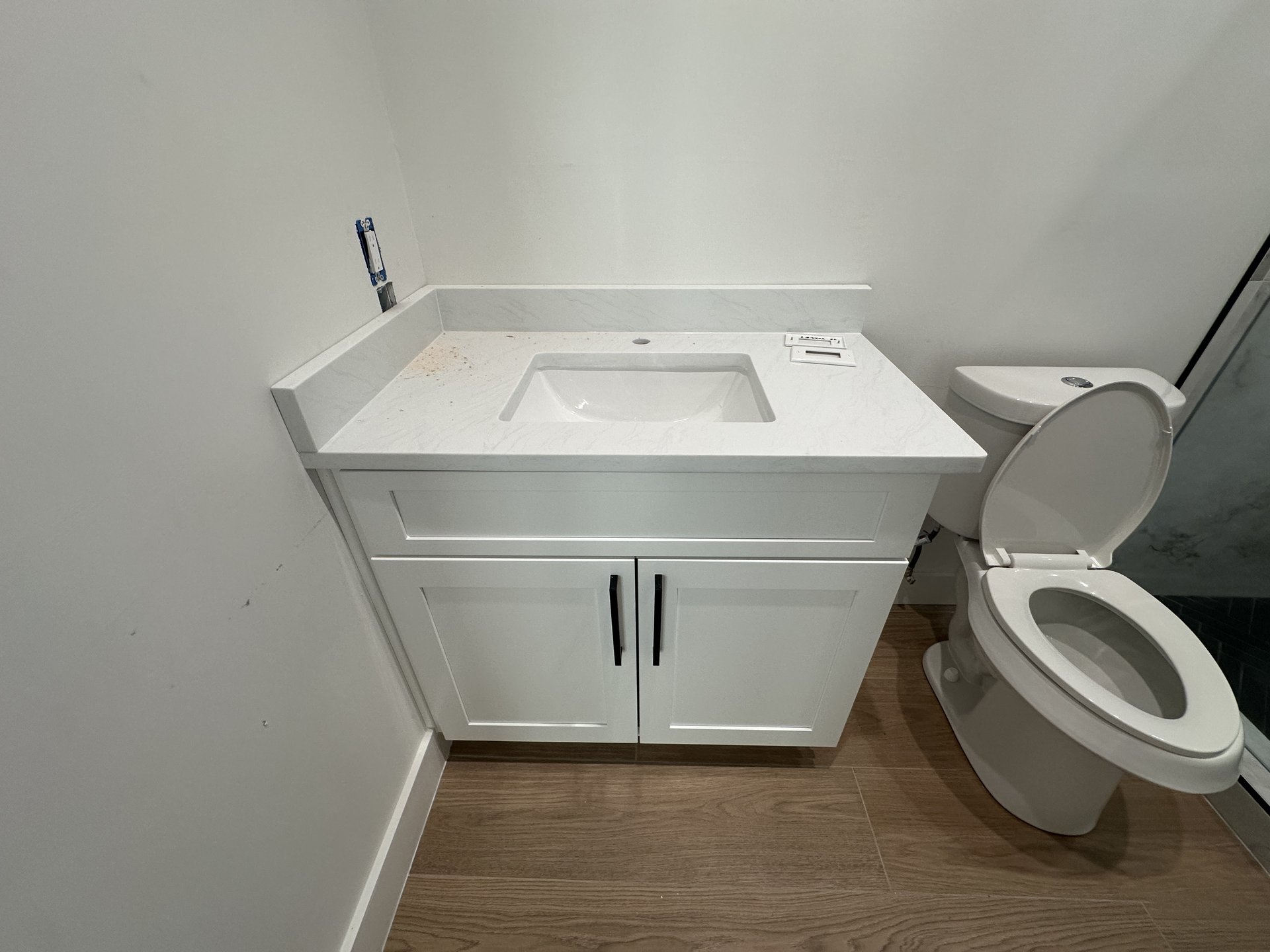
The cabinet door style you choose fundamentally shapes your space's aesthetic—from sleek modern minimalism to timeless traditional elegance. But door styles aren't just about looks; they also impact construction methods, durability, maintenance, and cost.
In this comprehensive guide, we'll explore the two most popular door styles: flat panel (slab) and Shaker. You'll learn how each is constructed, what finishes work best, and which style suits your design vision and lifestyle—especially important for Houston's humid climate.
Flat Panel (Slab) Doors: Modern Simplicity
What Are Flat Panel Doors?
Flat panel doors (also called slab doors) are single, smooth pieces with no decorative details or raised profiles. They epitomize modern, minimalist design with clean lines and an uninterrupted surface. This simplicity is both their defining aesthetic and their functional advantage.
How We Make Flat Panel Doors
Our flat panel doors use either particleboard or MDF as the core material. These boards typically come pre-finished from suppliers with your chosen surface material already applied:
Construction Process:
- 1. Start with particleboard or MDF core
- 2. Apply finish surface (melamine, laminate, or acrylic)
- 3. Cut to exact dimensions for your cabinets
- 4. Add edge-banding to all exposed edges
- 5. Install hardware mounting points
Finish Options for Flat Panels
Melamine (TFL)
Budget-friendly, durable
- • Scratch-resistant
- • Wide color selection
- • Excellent for closets
- • Most affordable option
Laminate (HPL)
Mid-range, versatile
- • Impact-resistant
- • Texture variety
- • Moisture-resistant
- • Great for kitchens
Acrylic
Premium, high-gloss
- • Glass-like finish
- • UV-stable
- • Modern aesthetic
- • Luxury option
Why Edge-Banding Matters
Edge-banding is critical for flat panel doors. This thin strip of matching material covers the exposed core edges and serves two essential purposes:
Moisture Protection
Seals the porous core from Houston's humidity, preventing swelling and water damage. This is especially crucial for sink base cabinets and bathroom vanities.
Aesthetic Continuity
Matches the surface finish color, creating a uniform appearance. Without proper edge-banding, you'd see the raw core material—unattractive and unprofessional.
Flat Panel Advantages
Shaker Doors: Timeless Classic Style
What Are Shaker Doors?
Shaker doors feature a recessed center panel surrounded by a raised frame, creating a subtle profile and shadow line. This design originated with the Shaker religious community in the 1700s, valued for its functional simplicity without unnecessary ornamentation. Today, Shaker style is one of the most popular cabinet door designs, working in both traditional and transitional kitchens.
How We Make Shaker Doors (The YuDezign Method)
Here's where our approach differs from traditional Shaker construction—and why it matters for Houston's climate:
Traditional Shaker Construction (We Don't Use This)
Traditional Shaker doors are made from 4-5 separate pieces of solid wood:
- • Two vertical stiles (sides)
- • Two horizontal rails (top and bottom)
- • One floating center panel
The center panel "floats" in a groove to allow for wood movement as humidity changes. While this works in stable climates, Houston's extreme humidity swings cause joints to separate and panels to crack over time.
Our Single-Piece MDF Method
We carve the Shaker profile from a single piece of MDF using CNC routing:
- Start with 3/4" MDF board - Doesn't expand/contract with humidity
- Route the profile - Create the recessed center and raised frame from one piece
- Apply finish - RTF (thermofoil) or paint for seamless appearance
- Edge-band all sides - Seal and match the finish color
Result: No joints to fail, no wood movement, superior durability in Houston's climate.
Important: Our Shaker Doors Are Not Real Wood
This is critical to understand when selecting Shaker cabinets from us. Some customers specifically want "real wood" Shaker doors because they value the traditional craftsmanship and natural wood grain. We need to be clear: our Shaker doors are MDF with RTF or painted finishes, not solid wood.
Why We Don't Use Solid Wood:
- Wood expands up to 8% in Houston's humidity
- Joints separate as wood moves seasonally
- Finishes crack and peel from movement
- Requires constant maintenance
Benefits of MDF Shaker:
- Zero dimensional change with humidity
- No joints means nothing to separate
- Finish stays intact for decades
- Minimal maintenance required
Finish Options for Shaker Doors
RTF (Rigid Thermofoil)
Vinyl film vacuum-pressed over the MDF, creating a seamless, waterproof surface. Perfect for mimicking painted wood without the maintenance.
- Moisture-resistant
- Easy to clean
- Won't chip or peel
- Wide color selection
Paint
Applied directly to the MDF surface for custom colors. MDF's smooth surface accepts paint beautifully without showing grain.
- Unlimited color options
- Custom color matching
- Matte or semi-gloss finish
- Requires more care (can chip)
Shaker Style Advantages
Why We Don't Make Raised Panel Doors
You may have noticed we haven't mentioned raised panel doors—the traditional style with an elevated center panel. These are considered specialty products and we don't manufacture them for several reasons:
- Complex multi-part assembly - Requires joining 5+ separate pieces, each needing precise milling
- Wood movement problems - Traditional construction with solid wood fails in Houston's humidity
- Higher cost - Labor-intensive production significantly increases price
- Harder to clean - Deep grooves trap grease and require more maintenance
For customers wanting more decorative detail than flat panel but concerned about maintenance, we recommend our Shaker style—it provides visual interest without the complications of raised panel construction.
Side-by-Side Comparison
| Aspect | Flat Panel | Shaker |
|---|---|---|
| Style | Modern, minimalist, contemporary | Traditional, transitional, farmhouse |
| Construction | Single smooth piece | Carved profile in MDF |
| Finishes | Melamine, laminate, acrylic | RTF, paint |
| Maintenance | Easy - wipe clean | Moderate - grooves need attention |
| Cost | Lower | Moderate |
| Lead Time | Faster (2-3 weeks) | Standard (2-3 weeks) |
| Houston Climate | Excellent | Excellent (MDF method) |
Which Style Should You Choose?
Choose Flat Panel If:
- You prefer modern, minimalist aesthetics
- You want the easiest maintenance possible
- Budget is a primary concern
- You want high-gloss acrylic or bold colors
- Your home has contemporary architecture
Choose Shaker If:
- You prefer traditional or transitional style
- You want subtle visual interest and depth
- You're thinking about resale value
- You like painted or RTF finishes
- Your home has classic or farmhouse style
Key Takeaways
- Flat panel doors are simple, modern, and low-maintenance - Perfect for contemporary spaces and busy households.
- Shaker doors provide timeless appeal - Our MDF construction eliminates traditional wood movement problems.
- Edge-banding is critical for both styles - Protects against Houston's humidity and creates a polished appearance.
- Our Shaker doors are not real wood - MDF with RTF or paint provides superior performance in humid climates.
- Both styles perform excellently in Houston - When properly constructed with engineered materials and sealed edges.
See Door Styles in Person
Visit our showroom to see flat panel and Shaker samples in various finishes. Touch the materials, see the construction quality, and find the perfect style for your project.
Schedule Showroom Visit