European vs American Kitchen Cabinets: What's the Difference?
 By YuDezign Team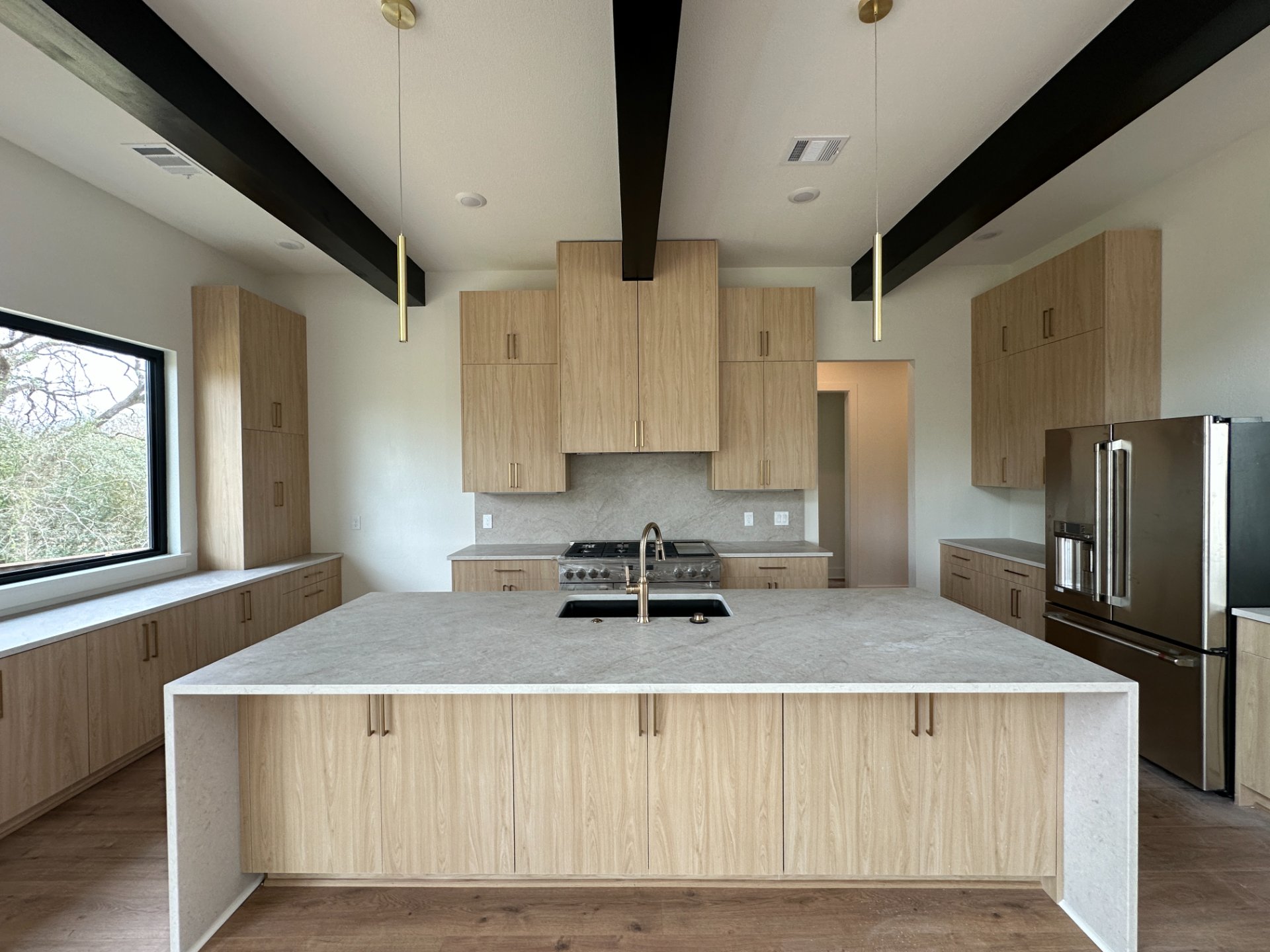
When shopping for kitchen cabinets in Houston, you'll encounter two distinct manufacturing philosophies: European (also called "frameless" or "full-access") and American (also called "framed" or "face-frame"). These differences go far beyond construction—they reflect different design aesthetics, manufacturing traditions, and functional priorities. Understanding these distinctions helps you choose the right style for your home.
At a Glance
European Cabinets
- • Frameless construction (no face frame)
- • Concealed hinges, sleek hardware
- • Modern, minimalist aesthetics
- • 32mm system standardization
- • Maximum storage efficiency
American Cabinets
- • Face-frame construction
- • Exposed or semi-concealed hinges
- • Traditional, classic styling
- • Custom craftsmanship focus
- • Stronger frame structure
Historical Background
The differences between European and American cabinets stem from distinct manufacturing traditions:
European Cabinet Evolution
European cabinet design emerged from post-WWII reconstruction needs. German and Italian manufacturers developed:
- Standardized systems: The "32mm system" created universal drilling patterns for shelves and hardware, enabling factory automation and mass production efficiency.
- Frameless construction: Eliminating face frames saved materials (critical in post-war Europe) and maximized storage in small urban apartments.
- Concealed hinges: Hidden Euro-style hinges aligned with minimalist Bauhaus design principles—clean lines, no visible hardware.
- Modular approach: Standardized cabinet boxes (300mm, 450mm, 600mm widths) simplified manufacturing and installation.
Brands like Bulthaup, Poggenpohl, SieMatic, and Leicht pioneered European design—emphasizing engineering precision, material efficiency, and contemporary aesthetics.
American Cabinet Tradition
American cabinets evolved from furniture-making traditions:
- Face-frame construction: 1.5"-2" hardwood frame attached to box front provided strength for heavy solid wood doors and aligned with American furniture craftsmanship.
- Custom craftsmanship: Each kitchen built as unique project by skilled cabinetmakers, with hand-fitted doors and site-built details.
- Decorative elements: Crown molding, corbels, furniture feet, and ornate details reflected American preference for traditional styling.
- Visible hardware: Decorative hinges, knobs, and pulls were features to showcase, not hide.
American manufacturers like KraftMaid, Merillat, and countless local cabinet shops maintained these traditions, adapting slowly to European influences.
Construction Differences Explained
The fundamental construction difference affects everything else—storage, aesthetics, hardware, and price:
| Feature | European | American |
|---|---|---|
| Box Construction | Frameless—no face frame. Doors mount directly to 3/4" thick box sides. | 1.5"-2" hardwood face frame attached to box front. Doors mount to frame. |
| Box Material | 3/4" plywood or melamine-covered particleboard (thicker for strength). | 1/2" plywood or particleboard (frame provides strength). |
| Door Overlay | Full overlay—doors cover entire box edge, small 2-3mm gap between doors. | Partial overlay, full overlay, or inset—frame visible or completely hidden. |
| Opening Access | Full-width access—no frame obstruction (10-15% more usable space). | Frame reduces opening by 1.5" each side (less access). |
| Hinge Type | Euro-style cup hinges—fully concealed, 6-way adjustable. | Butt hinges (exposed) or semi-concealed—limited adjustment. |
| Shelf Holes | 32mm system—standardized hole pattern every 32mm for shelf pins. | Custom-drilled holes—spacing varies by manufacturer. |
For detailed frameless vs. framed construction comparison, see our article:Frameless vs Framed Cabinets.
Design Aesthetics & Style Differences
Construction differences drive distinct aesthetic philosophies:
European Design Philosophy
European Aesthetic Characteristics
- Minimalist & clean: Horizontal lines, flush surfaces, minimal ornamentation. "Less is more" Bauhaus principle.
- Handleless designs: Push-to-open mechanisms, integrated edge pulls, or horizontal grooves eliminate protruding hardware.
- High-gloss finishes: UV-cured lacquer, acrylic, or glossy laminates create reflective, modern surfaces.
- Slab doors: Flat panel doors with no frame or detail—pure geometric form.
- Integrated appliances: Refrigerators, dishwashers hidden behind matching cabinet panels for seamless appearance.
- Floating effect: Recessed toe kicks, LED lighting, wall-mounted units create visual lightness.
American Design Philosophy
American Aesthetic Characteristics
- Traditional warmth: Emphasis on wood grain, painted finishes, and furniture-like details.
- Decorative hardware: Knobs and pulls as design features—oil-rubbed bronze, polished nickel, antique brass.
- Matte finishes: Painted surfaces with satin or matte sheen, natural wood stains showing grain.
- Frame-and-panel doors: Shaker style, raised panels, beadboard—visible craftsmanship and detail.
- Furniture details: Crown molding, corbels, legs, turned posts add architectural character.
- Freestanding look: Islands with legs, hutch-style upper cabinets mimic furniture pieces.
Modern convergence: Many contemporary cabinets blend both traditions. European manufacturers now offer Shaker-style doors, while American brands produce frameless boxes. "Transitional" style—combining Shaker doors with frameless construction—is extremely popular in Houston's market.
Hardware & Functionality Differences
European Hardware Systems
- Blum, Hettich, Grass hinges: Top European hinge manufacturers dominate global market. Soft-close standard, 3-dimensional adjustment (up/down, left/right, in/out). Lifetime warranties common.
- Undermount drawer slides: Blum Tandem, Grass Dynapro, Hettich InnoTech systems mount under drawer box—invisible, full-extension, 100-lb+ capacity, soft-close integrated.
- Lift systems: Aventos, Servo-Drive motorized lifts for overhead cabinets. Push-to-open drawers, touch-latch doors eliminate handles entirely.
- Corner solutions: LeMans corner units, Magic Corner pull-outs, Curve carousel systems maximize blind corner access far beyond lazy Susans.
- Organization accessories: Cutlery trays, spice pull-outs, waste bin systems precisely engineered to fit standardized cabinet widths.
American Hardware Approach
- Decorative hinges: Exposed butt hinges in decorative finishes (oil-rubbed bronze, aged copper) or semi-concealed hinges. Soft-close available but requires add-on adapters.
- Side-mount drawer slides: Ball-bearing slides mount to drawer sides—visible when drawer opens. Full-extension, soft-close available. 75-100 lb capacity typical.
- Traditional hardware: Knobs and pulls as key design elements. Wide variety of styles— traditional, rustic, contemporary. Finish matching critical to overall design.
- Custom solutions: Corner lazy Susans, pull-out shelves, tray dividers—often aftermarket additions rather than integrated systems.
- Mix-and-match: American cabinets increasingly incorporate European hardware (Blum hinges, Grass slides) for superior functionality while maintaining traditional aesthetics.
Manufacturing & Customization Differences
European Manufacturing
- Factory automation: CNC machining, edge-banding, drilling all automated. Consistent quality, fast production.
- Modular sizing: Standard widths in 50mm, 75mm, 100mm increments (300mm, 450mm, 600mm common). Filler strips used to fit exact spaces.
- Mass customization: Choose from standard sizes, vast finish options, integrated accessories. Not "custom" in bespoke sense but highly configurable.
- Lead times: Stock items ship in 2-4 weeks. Custom colors/finishes 6-10 weeks. European imports 12-16 weeks.
- Quality control: Precision tolerances (±0.5mm), computer-controlled processes ensure consistency across production.
American Manufacturing
- Custom fabrication: Many American shops build cabinets to exact dimensions needed— 122 3/8" exactly, not 48" standard + filler.
- Flexible sizing: 1/8" increments common. Can accommodate unusual heights, depths, and widths for challenging spaces.
- Craftsmanship focus: Hand-sanding, finish touchups, custom joinery still common in small American shops.
- Lead times: Stock cabinets 1-2 weeks. Semi-custom 4-6 weeks. Full custom 8-12 weeks. Local shops often faster than factory orders.
- Adaptability: Easier to accommodate last-minute changes, field modifications, one-off custom pieces (wine rack, pet feeding station).
Price Comparison
Pricing varies widely based on quality level, but general patterns exist:
| Quality Level | European Style | American Style |
|---|---|---|
| Budget/Entry | $150-$300/lf IKEA-style flat-pack, melamine | $100-$250/lf Stock cabinets, particleboard |
| Mid-Range | $300-$600/lf Semi-custom, plywood boxes, quality hardware | $250-$500/lf Semi-custom framed, hardwood frames |
| Premium | $600-$1,200/lf High-gloss acrylic, premium hardware, German/Italian | $500-$1,000/lf Custom hardwood, quality finish, local craftsman |
| Luxury | $1,200-$2,500+/lf Bulthaup, Poggenpohl, SieMatic—ultimate quality | $1,000-$2,000+/lf Full custom inset, exotic woods, furniture-grade |
Price Factors
European cabinets cost more at entry/mid levels due to thicker materials and premium hardware. At luxury level, prices converge—both styles use exceptional materials and craftsmanship. American custom inset cabinets (most labor-intensive) can exceed European imports in cost. For value-conscious Houston buyers, mid-range European-style frameless offers best storage-per-dollar.
For detailed pricing information, see our 2025 Custom Cabinet Cost Guide.
Which Style Is Best for Houston Homes?
Both styles work well in Houston, but consider these factors:
Choose European-Style If:
- You prioritize storage efficiency: Maximum usable space critical in smaller Houston homes or condos
- Modern aesthetics appeal: Contemporary, minimalist, or ultra-modern home design
- You want handleless design: Clean, sleek appearance without protruding hardware
- Advanced hardware matters: Soft-close everything, motorized lifts, premium organization systems
- Humidity resistance is priority: Frameless construction's monolithic design handles Houston climate well
- High-gloss finishes desired: UV-cured acrylic or lacquer creates dramatic, reflective surfaces
Choose American-Style If:
- Traditional aesthetics preferred: Classic, farmhouse, transitional, or Craftsman-style home
- You love decorative details: Crown molding, furniture feet, raised panels, visible craftsmanship
- Custom sizing needed: Unusual dimensions, challenging spaces requiring exact fits
- Natural wood grain important: Stained hardwood showing grain patterns rather than painted surfaces
- Hardware as design feature: Decorative knobs and pulls integral to overall look
- Supporting local craftsmen: Many Houston cabinet shops specialize in American-style face-frame construction
The "Transitional" Middle Ground
Many Houston homeowners choose the best of both worlds:
Transitional Style Combines:
From European Style:
- ✓ Frameless box construction
- ✓ Concealed European hinges
- ✓ Full-width storage access
- ✓ Premium soft-close hardware
- ✓ Clean, uncluttered lines
From American Style:
- ✓ Shaker or frame-panel doors
- ✓ Painted finishes (warm whites, grays)
- ✓ Decorative hardware (pulls, knobs)
- ✓ Some traditional details (crown molding)
- ✓ Furniture-like island design
Why transitional works: Combines European engineering/efficiency with American warmth/ familiarity. Extremely popular in Houston market—appeals to broad buyer demographic for resale.
Installation Considerations
European Cabinet Installation
- More precise requirements: Walls must be plumb, floors level within tighter tolerances. Frameless design shows imperfections.
- Specialized knowledge: Installers need experience with European hinges, 32mm system, adjustment procedures.
- Adjustment capability: Once installed, 6-way hinge adjustment makes tweaking easy—can perfect alignment years later.
- Cleaner installation: No scribing face frames to walls, no complex crown molding cuts. Filler strips handle gaps.
American Cabinet Installation
- More forgiving: Face frames hide wall irregularities. Can scribe frames to fit uneven walls/floors.
- Traditional skills: Most installers trained in face-frame methods. Wider availability of experienced installers.
- On-site customization: Easier to make field modifications, custom filler pieces, detailed trim work.
- Crown molding complexity: Installing crown molding adds time/skill requirement but creates finished furniture look.
Maintenance & Longevity
Both styles last 20+ years with proper care, but maintenance differs:
European Maintenance
- Hinge adjustment: Check annually, adjust with screwdriver—maintains perfect alignment easily
- Surface cleaning: High-gloss finishes wipe clean with microfiber cloth and glass cleaner
- Hardware replacement: Standardized parts—Blum hinges available globally, easy to replace
- Finish durability: UV-cured finishes extremely scratch-resistant, won't yellow or fade
American Maintenance
- Frame inspection: Check face frame joints for separation, re-glue if needed in high humidity
- Wood care: Natural wood finishes may need periodic re-oiling or waxing depending on finish type
- Hardware tightening: Screws in hinges and pulls may loosen over time—retighten periodically
- Refinishing option: Wood cabinets can be sanded and refinished if finish wears— advantage over laminate
Houston Market Trends
What are Houston homeowners choosing in 2025?
- New construction: 70% of Houston new builds specify European-style frameless cabinets, particularly in modern and contemporary homes.
- Remodels in traditional neighborhoods: Heights, Oak Forest, Garden Oaks homeowners often choose American-style cabinets matching home's 1940s-1960s character.
- Luxury market: Memorial, River Oaks, Tanglewood split between high-end European imports (Poggenpohl, SieMatic) and custom American inset cabinets.
- Suburban homes: Katy, Sugar Land, Pearland, The Woodlands favor transitional style— frameless boxes with Shaker doors.
- Resale consideration: European-style frameless cabinets command slightly higher resale premiums due to storage efficiency and modern appeal to younger buyers.
See current design preferences in Best Kitchen Cabinet Trends for Houston Homes 2025.
Frequently Asked Questions
Can I get Shaker-style doors on frameless cabinets?
Are European cabinets better quality than American?
Which style is better for Houston's humidity?
Can I mix European and American cabinets in the same kitchen?
Do European cabinets really provide more storage space?
Explore Both Styles in Our Houston Showroom
See European and American cabinets side-by-side with expert design guidance
Final Thoughts
The European vs. American cabinet debate isn't about which is objectively "better"—both manufacturing traditions offer excellent quality when properly executed. The choice depends on your aesthetic preferences, functional priorities, and budget.
European-style cabinets excel at storage efficiency, modern aesthetics, and advanced hardware systems. They're ideal for contemporary homes, space-conscious designs, and buyers who value sleek minimalism.
American-style cabinets shine in traditional settings, offer superior customization flexibility, and deliver the warmth and character of fine furniture. They're perfect for classic homes, buyers who love decorative details, and those supporting local craftsmanship.
Many Houston homeowners choose transitional style—combining the best of both worlds with frameless construction and traditional door styles. Visit a showroom to see both styles in person, open the doors, test the hardware, and determine which approach feels right for your home. The "right" choice is the one that matches your vision, lifestyle, and budget.